October 9th, 2008
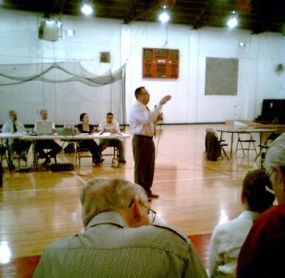
I attended a county tax auction for land on September 24, 2008 in Sandoval County, NM. Despite the financial crisis due to the credit crunch, falling stock market and falling Real Estate prices there was a healthy attendence at the tax auction. Approximately one hundred bidders participated and this was about the same as the county auction in April of this year. The auction prices were also similar.
I talked to some of the participants and they were hoping that there would be a lower participation and hence lower land prices, but that was not the case.
People are still considering land to be a solid investment.
by Andreas Paramonoff
Tags: financial crisis, land, real estate, tax auctions
Posted in Uncategorized | 2 Comments »
October 2nd, 2008
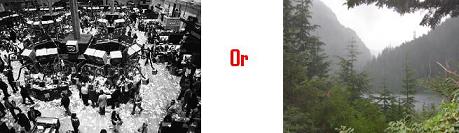
In the credit crunch and economic crisis it makes even more sense to have quality land as part of you portfolio for these reasons:
1. Its a hedge against inflation. The currency can be inflated by the politicians, but they can’t print anymore land.
2. It is a hedge against deflation. Deflation causes financial instituiton failures and that doesn’t effect your land.
3. It is not dependent on someone elses promise. Bank instruments, money market funds, stocks bonds are dependant on some company to fulfill its obligations. Land is yours, plain and simple.
4. All these bailouts will lead to higher taxes. Doesn’t effect land in the short term since you can just hold it and not sell.
5. Currencies can go up and down. Your land will stay.
6. No matter what happens, you have a nice piece of land that is yours.
by Andreas Paramonoff
Tags: credit crunch, crisis, economy, land, real estate
Posted in Uncategorized | 5 Comments »
September 28th, 2008
Unlike developed real estate it is much more difficult to get financing on vacant land other than financing provided by the owner. It is more difficult to get financing on larger and more remote properties.
Finance companies have a hard time valuing land if it is large because the value may be speculatively high due to potential subdividing. The potential value of remote property can also change significantly due to changing road conditions, availability of water, septic drainage, zoning and many other factors. Finance companies don’t want to risk their money.
Owner financing is often the best choice available, but since most sellers want cash the price for a cash purchase for remote land is much less than financed, sometimes by half.
There are two primary methods in which owner financing is done. One is a sales contract in which the seller keeps title of the property until all payments have been made and at that point the seller deeds the property to the purchaser. If the purchaser defaults then the seller typically notifies the purchaser of the default and keeps all payments made. The courts may limit the amount the seller can keep, for example the California Supreme Court, in Smith vs Allen 1968 C.2d 93 allowed the purchaser to get back amounts in excess of fair rent so that is does not unjustly enrich the seller. Other court cases protect the purchaser if substantial payments or improvements have been made, for example see California Supreme Court case of Petersen v Hartell (1985) 40 C.3d 102. In these cases a quiet title action may be needed to terminate the contract. Some states have laws to further protect the purchaser in these sales contracts and specify steps required to terminate a contract in the event of a default. A real estate sales contract can also in some instances be recorded in the county by the purchaser to protect their interests provided that the seller has acknowledged the contract. Title insurance can also be available for land contracts.
The other method of owner financing is deeding the property to the purchaser and registering a mortgage or trust deed which is released or reconveyed when all paymen ts have been made. Due to the potential costs of a foreclosure, this method is usually used if a significant downpayment is used.
There are many laws governing seller financing that both the seller and purchasers need to investigate. For example, in California a real estate license is required if an owner buys or sells more than eight properties in a year which are secured by a note or sales contract.
This article is not intended to provide legal advice, but just to start a discussion on the financing options available. I recommend reviewing your situation with a attorney.
by Andreas Paramonoff
Tags: finance, land, mortgages, real estate
Posted in Uncategorized | No Comments »
May 6th, 2008
If someone is selling land for a profit then it is a capital gain and the taxes can be deferred over the period of time the sale is being financed by the seller. The capital gain rate is also lower if the property was held for a year or longer.
Sounds good, doesn’t it? But wait, if the tax department considers the seller to be a dealer then all the tax must be paid in the year the property is sold even if the seller is collecting the proceeds over a long period of time. The tax rate is also the tax payers high marginal rate, not the capital gain rate.
Consider the implications. You could sell a property and be paid over ten years, but all the taxes are due in the first year. For the first few years you could be paying money to sell the property.
What constitutes being a dealer? This depends on the intent of the seller. The intent is determined by the number of lots being sold, the reason for selling them, the use of the lots being sold, the length they were help and the nature of the improvements and development. Two people could own identical lots side by side, sell them for the same price, but be tax very differently on the profits. A real estate tax professional will help in determining your status.
There are some schemes for a dealer deferring the taxes such as considering it an uncompleted sale until all payments are made or selling the notes to another company of yours for a discount. I don’t recommend these schemes and they could get you into tax trouble.
On the bright side, the determination of whether or not you are a dealer is done per property. This means you could have some properties which could be sold for capital gain and some which are sold as a dealer.
I am not a tax advisor and have just provided this information to make people aware of the need to consider the tax implications for raw land buying and selling. I recommend reviewing your situation with a tax advisor.
by Andreas Paramonoff
Tags: capital gains, land, land dealer, real estate, tax
Posted in Uncategorized | 2 Comments »
April 26th, 2008
Purchasing a remote piece of property can be an exciting experience, but actually finding it can a big challenge. It can take a lot of research and effort in finding it.
On my first visit to a piece of property my research was useless because there was a gate on the road I thought I could use. I ended up going cross country with my compass and eventually I found the lot and I enjoyed a camp on my very own property.
In the time since I have encountered many people who have looked for property they bought and never found it. In fact, in for remote properties the vast majority of people I talked to did not find their land on their first trip.
This document should help in getting started in finding remote properties.
by Andreas Paramonoff
Tags: compass, gps, land, map, plat map, real estate, roads
Posted in Uncategorized | 2 Comments »
April 23rd, 2008
This blog is a place for information, advice, tips or stories about owning remote and rural land. Anyone interested in land is encouraged contribute.
Tags: land, real estate
Posted in Uncategorized | No Comments »

